熊出没
Highest-ranking Xia Dynasty noble tombs discovered in China, dating to the age of Minoan Crete_我的网站

一 |
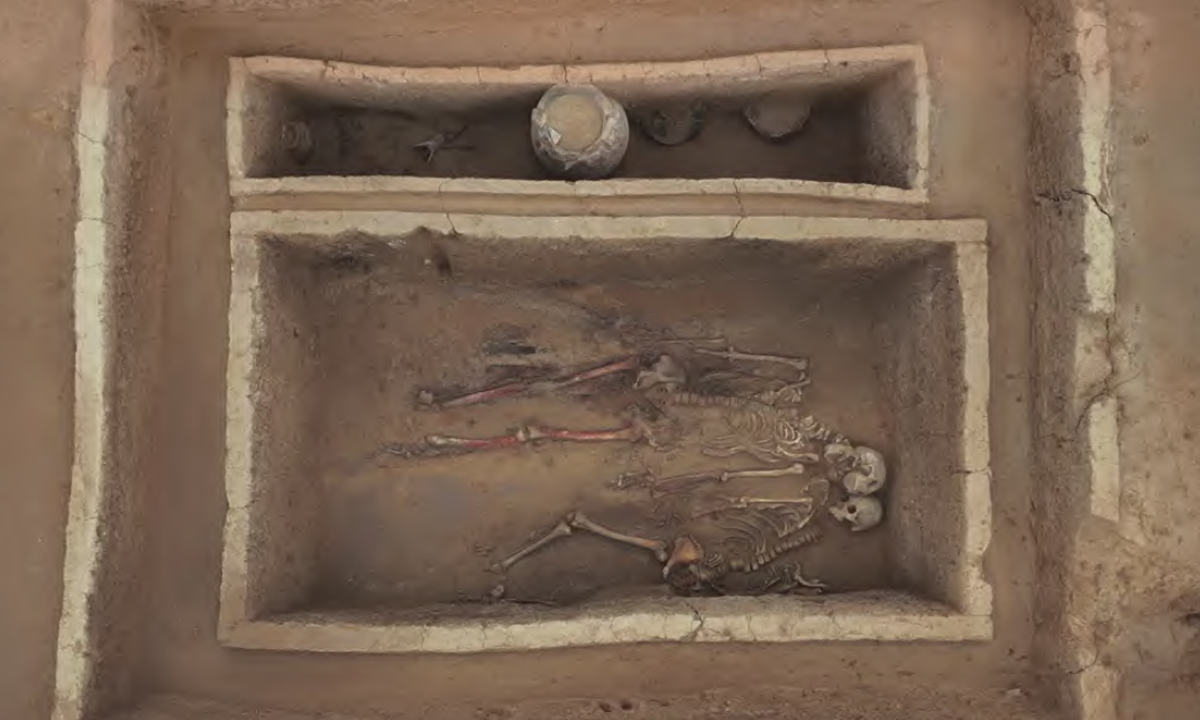
Coffin chamber M13 Photo: Courtesy of the Shanxi Provincial Institute of ArchaeologyThe highest-ranking noble cemetery complex from the late Xia Dynasty (c.2070BC-c.1600BC) ever discovered has been unearthed at the Zhongcun site in North China's Shanxi Province, expanding research on Xia and Shang (c.1600BC-1046BC) civilizations and early state formation in ancient China, according to a press release that the local institute of archaeology sent to the Global Times on Monday.
Located on a hilly terrace west of the Taihang Mountains and flanked by the Songxi River, the site was excavated in 2024 and 2025 by the Shanxi Provincial Institute of Archaeology and partner institutions, leading to the discovery of 18 tombs, including six Xia Dynasty burial sites and 12 Warring States Period (475BC-221BC) graves.
"These are the highest-ranking Xia aristocratic tombs discovered so far, indicating that this location was a regional center," the institute said.
The Xia Dynasty is traditionally regarded as China's first hereditary dynasty, though contemporaneous written records are lacking.
The well-organized Xia tombs, concentrated in the western part of the cemetery, feature uniform east-west oriented vertical earthen pits. Researchers recovered nearly 40 sets of artifacts with distinctive local cultural characteristics, including pottery, lacquerware and turquoise ornaments.
Extended regional surveys across the Songxi River valley yielded more than 10 Xia and Shang period sites. Test excavations at nearby relic sites unearthed pottery fragments, stone tools, bronze knives, as well as tin-bronze ingots and smelting residue, providing solid evidence of early metal mining and craftsmanship.
Local copper-iron symbiotic ore deposits confirm exploitation of these resources during the Xia and Shang eras, while typical cultural artifacts found in adjacent counties reveal widespread regional cultural exchange.
Multidisciplinary analyses further decoded the civilization's features. Ancient human remains belong primarily to the ancient population of the Central Plains with minor Mongolian Plateau genetic traits, forming a stable patrilineal clan. The community relied on millet farming and maintained long-distance resource trade networks.
Artifact provenance tests trace scallop shell ornaments to the Bohai Sea, cinnabar to Hunan-Guizhou ore belts, turquoise to the eastern Qinling Mountains area, and coffin timber to local Taihang pine trees. Such diverse materials reflect close interaction among the Taihang foothills, the press release noted.
Lab restoration unveiled refined ritual relics, including a dragon-patterned lacquer cylinder with red and black stripes and an intact lacquer gu vessel (a type of wine vessel). Turquoise plaques from the site match specimens from the Erlitou site, a core Xia cultural relic, proving cross-regional cultural interaction. Radiocarbon dating places the site's active period between 1880BC and 1450BC, aligning with the late Xia Dynasty.
Scholars confirmed the findings have helped reshape academic understanding of Xia-Shang civilizations and reconstruct multi-level settlement patterns on the western Taihang foothills, while offering new insights into social complexity and civilization development in early China.
。
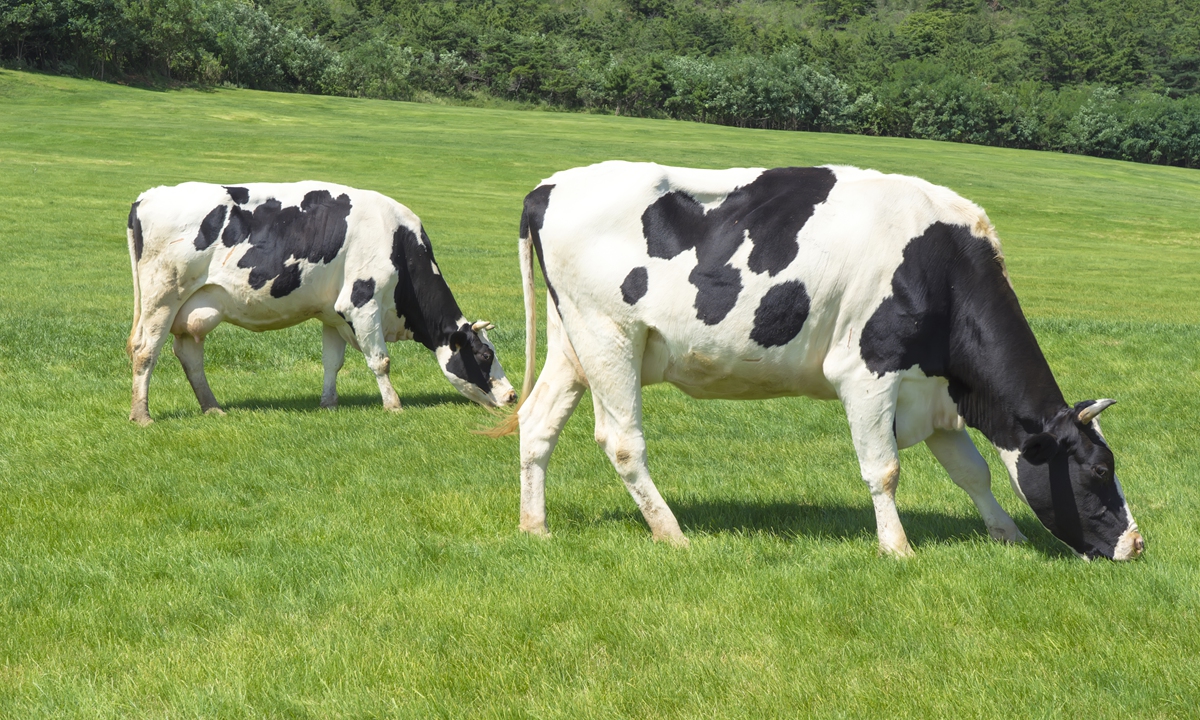
Cattle Photo: VCG
North China's Inner Mongolia Autonomous Region has launched a genomic breeding tool for dairy cattle, also known as a gene chip, enabling precise screening for key traits such as high milk yield, high fertility, disease resistance and longevity, and marking a fresh breakthrough in China's dairy cattle breeding technology, the Inner Mongolia Daily reported on Saturday.
As an iteration of the previous generation dairy cattle breeding array, which holds proprietary intellectual property rights, the new-generation "Breeding No.2" breeding array was led by the National Center of Technology Innovation for Dairy and developed by Youran Dairy Saikexing, with upgrades in loci coverage, compatibility and gene-trait prediction algorithms.
The "Breeding No.2" breeding array covers about 50,000 loci across the dairy cattle genome, with a focus on functional loci tied to milk production, reproduction, disease resistance and length of productive life. It has achieved a sample call rate of 99.65 percent and a genotyping concordance rate of 99.91 percent for duplicate samples, and is compatible with mainstream international chips, allowing historical breeding data to be shared and reused.
Drawing on a phenotype database and genome resequencing data to optimize a proprietary algorithm, advancing breeding evaluation from qualitative screening to quantitative assessment, bringing the accuracy of breeding stock selection up to advanced international levels, according to the report.
The breeding array enables more precise genomic selection of calves at an early stage, substantially shortening the generation interval in breeding bull selection and cutting spending on raising low-performing replacement heifers. Compared with imported high-density chips, the "Breeding No.2" chip carries a lower per-sample testing cost and delivers stronger input-output returns, making it highly suited to large-scale dairy cattle breeding operations in China, the report said.
Global Times
。
Current article:http://p15al.guaxiazaopinduan.cfd/list_2ek69ji/24q.html
Published on:14:18:22
 美国大选4月形势:民调与初选
复仇者联盟2
美国大选4月形势:民调与初选
复仇者联盟2
 英格兰输球后,贝林厄姆击打对手引发冲突
家事
英格兰输球后,贝林厄姆击打对手引发冲突
家事
 外星区-51m追光笔记本上架:台式i9/rtx 2080,47999元
性爱大师
外星区-51m追光笔记本上架:台式i9/rtx 2080,47999元
性爱大师
 5年1.25亿~霍里:布劳恩是NBA溢价最严重的合同 他该给德罗赞替补
wps
5年1.25亿~霍里:布劳恩是NBA溢价最严重的合同 他该给德罗赞替补
wps
 美团外卖单无骑手接,找客服无果只能取消
夫妇飞美国打儿媳
美团外卖单无骑手接,找客服无果只能取消
夫妇飞美国打儿媳
 第十一届京台青年创新创业大赛在京落幕
七宗罪
第十一届京台青年创新创业大赛在京落幕
七宗罪
 2025重庆车展:比亚迪海豹06EV售10.98万起
天涯明月刀
2025重庆车展:比亚迪海豹06EV售10.98万起
天涯明月刀
 韩国警方对总统警卫处警卫本部长李光宇发布逮捕令
如果我爱你
韩国警方对总统警卫处警卫本部长李光宇发布逮捕令
如果我爱你
 区农业农村局全链条发力筑牢防汛屏障
妈妈咪呀
区农业农村局全链条发力筑牢防汛屏障
妈妈咪呀

 微信
微信 移动端
移动端